Thursday, November 20, 2008

Demand in the Home Service Categories

Some anecdotal evidence about the big-revenue home services categories the local business depends on so much. During the Kelsey get-together in No Cal, some industry people have indicated that because the home services companies are now less busy (because of decreasing home equity withdrawals to fund improvements), they're looking for more lead sources (although they also mention those lead costs are decreasing)...

Kelsey Group Blogs » Insigthts from Home Services Heavyweights

Tuesday, November 18, 2008

Yelp Stats

Some great stats from Yelp. 15MM users a month is nothing to sneeze at, and if they start to trust Yelp for Restaurants, etc, it's only a matter of time before they start using it for high-revenue categories too...

Kelsey Group Blogs » Yelp Traffic Stats Suggests Broad Local Usage

Wednesday, November 12, 2008

Free Print Ad with Online?

It's only for jobs and only for a test period, but the NYTimes is offering their online job advertisers free print ads when they buy an online one. This is going to become more and more frequent as print advertising degrades to such a level (especially in classifieds categories) that, by itself, it wouldnt provide enough content for print readers. So, to fill in content in print and retain any readers it has, print publications will have to go in this direction. A first shot over the bow perhaps?

Print in Crisis: NYTimes Gives Ads Free Paper

Tuesday, November 11, 2008

MLS going direct to consumers

Trying to build a real estate site (a huge local category) one of the problems has always been where to get the data. Working with MLSs is the best way to get data, but they're all regional and not all that easy to work with. To get national coverage, you need to do a lot of deals, and as you can see from sites like Redfin, Trulia, etc, its just not that feasible. A new site called HomesDatabase has been created by an MLS in the mid-Atlantic part of the country and is one example of MLSs trying to expand their business model. Their goal is to go national, but we'll see if they have any more luck than the rest. At the very least, though, if local MLSs all over the country do this and allow sharing of their data, aggregator sites will have some good stuff to work with.

MLS Tired of Zillow, Trulia: Goes Direct To Consumers

Monday, November 10, 2008

Writeup of 15 Local iPhone Apps

Yelp is still the best in my view, though the Google Earth one is pretty sweet as well...

15+ FREE iPhone Apps to Navigate Your World

Financial Discussion of YP Companies

Interesting summary of a financial article on the state of the Yellow Pages business...

Dense ‘Deal’ Piece on YP « Screenwerk

Tuesday, September 16, 2008

Google Maps Listing Quality Guidelines

Some good info from Google on how to submit good listings to their maps site and avoid being Map spam...

Google Maps Adds Business Listing Quality Guidelines

Local Video Spam!

Leave it to MerchantCircle to figure out how to game the system. They've done a big deal with Spotzer (similar to Spotrunner, etc - produce local videos) to produce thousands and thousands of video ads for local businesses. They'll use the businesses information to create the ads, but from the looks of the sample, they aren't doing any customization or adding any information, real value, or real images or video of the business. Here's the text from the sample ad (a home theater store in Tennessee):

"When it comes to shopping, it's not easy to find just the right thing. Well look no further. We've got what you're looking for" (business name, phone number, city state and zip shown at the end - no street address)

So, what's the point of these ads, since they don't really provide any information on the business. They don't even include the street address, just a phone number (most likely a tracking number) and City information? The point is to be taken in by Google as "video spam", hoping Google will index the city information and phone number. If a user looking for information does see this, they'll have to call the number or click through to get any real information. This is what makes it spam. No real value or information, just there to fool Google. Let's hope they're too smart for this. But that's MerchantCircle for you.

MerchantCircle and Spotzer Partner for SMB Vids « Screenwerk

Tuesday, September 9, 2008

Phone Book Myth on Mythbusters This Week

For those of you who can't get enough of Local (and Yellow Pages specifically) at work, Mythbusters is doing an episode this week that includes a YP myth (there seems to be a myth that if you collate 2 phone books together, their pages will magically stick). I've never heard this myth before but apparently it exists. Tune in to the Discovery Channel Weds at 9PM Eastern/Pacific.

Mythbusters Phone Book Episode Schedule

The Worlds Oldest Phone Book


Time for the lighter side of local. Christie's auction house has just auctioned off the world's oldest phone book. It had a residential directory and a yellow pages. Here's the great part, though: There aren't any phone numbers in it, just a list of people who have phones (I guess you just asked the operator for the person you wanted). If you click through, there's a video of it too. No mention of what it sold for.

Video: the world's oldest telephone book - Boing Boing

Drop in Real Estate Newspaper Advertising

Adding to the earlier story about newspapers losing money, look at this chart, from the Trulia Blog, another of those sites I mentioned that's killing the papers' classifieds business.


Ouch! Trends in Newspapers and Real Estate Advertising

Monday, September 8, 2008

Can Newspapers Be Saved? Here Are Some Ideas...

Building on the Newspaper discussion begun the other day, Search Engine Land has an article asking the question Can Newspapers Be Saved and how? The gist of it is:
  1. This is the standard one we always hear. Advertiser relationships are the biggest asset for newspapers (just as they as for yellow pages), so they must defend those relationships and extend them, acting as trusted resources to provide a broad base of advertising products.
  2. Sell everything your advertisers want. Not just newspaper, but IYPs (YellowPages.com, SuperPages and Dexknows are mentioned) and other local Internet traffic sources like CitySearch.
  3. Focus on phone calls. As we've discussed here, most advertisers are not focused on directing clicks and traffic to their websites, except as it drives phone calls. Their sites are typically not optimized for conversion and they are not set up to do rapid responses to emails, so just skip the middle man and send the phone calls directly.
Everything else in here has to do with sales. Invest in your team, keep it easy to sell (this is a key - package products together rather than making it a complicated sale that seems like you're nickle and diming them), and make sure your sales comp is aligned with the new product set.

Sounds like pretty good advice. Will newspapers take it? That's another story...


Can Newspapers Be Saved? Part 2: Potential Solutions

Yelp 2.0 for iPhone on its Way


According to Greg Sterling, the next iteration of the Yelp iPhone app is coming. The first version is by far my favorite local app on the iPhone, and it sounds like this one will only improve on it, offering more information, more search options and some other fun things on top of it. These guys definitely get how to build an iPhone app.

Yelp 2.0 for the iPhone Coming Soon | LocalMobileSearch

Friday, September 5, 2008

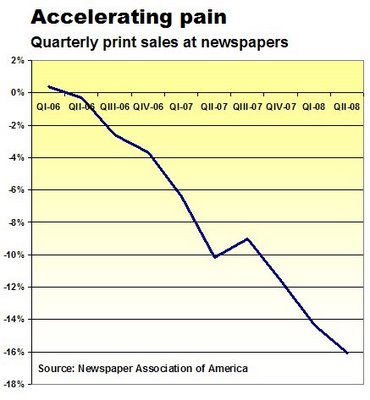
Newspaper Ad Revenues Dropping Fast


I don't post too much about newspapers here, but they are a large (though shrinking) and important part of the local advertising ecosystem. I've argued for a while that, while yellow pages companies are in a tough position, newspapers are even worse off. Why is that? Because they face a lot more competition and on different factors compared to YPs. Any local blogger can cover local news (sometimes better than the big papers, especially when you're talking about a neighborhood or smaller area). They can go deeper on topics, have a better understanding of the day-to-day life in an area and, most importantly, they can be more timely with their news delivery. While newspapers publish once a day (and their online schedules are not that much more frequent), bloggers publish anytime. And via blog readers and other notification channels, interested people can know the news as soon as it happens. While this will impact other local players, like radio and TV, the biggest impact is in the newspaper industry. Yellow Pages obviously face significantly new media competition as well, but it's not as likely that one person in their house will provide the same competition for YPs that they provide for newspapers.

So what's the point of all this? According to the Newspaper Association of America (via Techcrunch), newspaper advertising revenues have been dropping off a cliff. Not only that, but their Internet revenues are decreasing as well. Most people I know think we're in a recession and advertising is bound to drop off as a whole. But it definitely looks like newspapers are taking the brunt of it (though the YPs are not exactly feeling good either). Classified ads, one of the big revenue areas for newspapers, have been eaten away for a while now, by Craigslist and vertical sites like Rent.com, Realtor.com, Monster.com and the like. But now it seems like display is following, and it's just going to keep going down from here.

Negative Momentum: Newspaper Ad Revenues Gaining Downhill Speed (Even Online Is Declining)

What does a New Zealand YP Company have to do with us?

Kelsey group had an interesting writeup today of Yellow Pages Group New Zealand's acquisition of a majority stake in a couple sites targeted at people over 50. On it's face, seems like it's not a big deal, but thinking about it further, I tend to think this is a really astute move and something we should think about when looking to expand our local (and YP specifically) businesses in the US.

The core Internet demographic (teen-40 years old) are getting pretty locked in to going to Google or Yahoo or other Internet pure-play sites to get their information. It's that activity that's hurting YP revenues with those types of users. However, print Yellow Pages still experience strong usage among people 40 and over, and haven't slowed too much in that age group. However, that slowdown is likely to come, and before it does, Yellow Pages companies should be looking to expand their brand equity with that demographic by providing them with Internet destinations and experiences that suit their needs and wants. Similar to the posting I wrote about women being a core demo of YP sites online, I'm going to argue that we need to focus our experiences towards those customers who still provide us good usage, that we have not yet lost to the Internet pure-play companies.

YPGNZ has shown us an example of that kind of forward thinking, and we need to start thinking that way here as well.

Kelsey Group Blogs » Yellow Pages Group New Zealand’s Boomer Acquisition

Wednesday, September 3, 2008

Search Insider Recommends Yahoo! Buy RH Donnelly


What should Yahoo! do? How can they improve their business? How can they undo the major mistake they made in not selling to MSFT? Lots of people have their opinions, but according to the Search Insider column (via Greg Sterling), one of the recommendations is for them to buy a yellow pages company, specifically RHD. Why not Idearc? Not sure, any more than I'm sure why Barron's recommended RHD stock vs. Idearc.

But what this shows is that there are potential synergies between Search companies and Yellow Pages companies. Search, like many Internet businesses, has trouble getting a critical mass of small businesses. Yellow Pages companies have those relationships (and long-term established ones), but for the most part, don't have the Internet products to go with them. The question is going to be, does a Search company want to take a huge cut on their margins by acquiring a company that has a huge sales force in exchange for increasing their market share? I guess we'll see...

“Buy the Yellow Pages” Returns « Screenwerk

Friday, August 29, 2008

Taxonomy and Local Search

Kelsey references a piece from the head of BD at Localeze talking about Taxonomy and IYPs/Local sites. The gist of it is, we need to be designing these sites to be more than just category and geography driven and make them more focused around a search-based structure, where users can really search for what they need and not have to try to figure out what category to look for. This really gets back to that discussion that the last generation focused on browse by category and this generation is all about search.

Kelsey Group Blogs

Wednesday, August 27, 2008

Verticals in the Local Space

A "consultant specializing in vertical development" talks about how the local space has been slow to really build out Vertical sites, focusing on areas like auto, wedding, legal, etc. This is definitely a direction local sites need to go in, and the first site that gets to become a one-stop-shop, with solid content in all the major verticals, along with their core business listings, should gain good traction with users as their default local site. And the good news for all of us who aren't Google is that this is not the kind of thing they do, so the door is open for someone else to step through.

Kelsey Group Blogs » Vertical Slowdown? Teresa Lawlor Discusses Challenges

Tuesday, August 19, 2008

Medical Categories Slowly Moving Online


For traditional yellow pages companies, Doctors, Dentists and related categories are huge revenue generators. Online, though, they've been very slow to adopt (as with Real Estate, which we discussed yesterday). Several companies have tried different approaches to bring these categories online, like HealthGrades and several competitors, which offer reviews of medical professionals. Looks like there's another new site moving into this space, called ZocDoc, which has information on doctors, the insurance they accept and allows you to schedule appointments. Like many Local startups, I suspect this one is going to run into a Sales issue, with doctors being very busy people and their front offices not really being equipped to spend their marketing money. Like all categories, this one will eventually be fully engaged online, but for the time being, I think the YPs, IYPs and Google will be the primary resources they'll use.

ZocDoc Gets $3M to Help You Find a Doctor

Optimizing Google OneBox and Yahoo! Shortcut Local Listings

Good article talking about how to best optimize your business listings to get good Google and Yahoo! local placements.

Optimizing Google OneBox and Yahoo! Shortcut Local Listings

Monday, August 18, 2008

Barrons Promotes RH Donnelly as "Risky, But Attractive"


RHD's stock is up 14% at the moment based mostly on an article in Barron's which indicates that, despite the 97% drop in stock price in the last year, RHD's directories are still experiencing strong usage in some sectors and are "far from dead". The albatross, as they say, is the $9.7B of net debt the companies holds. But, as they say, if you're looking for a high-risk, potential high-return stock, RHD may be one to check out. This article made me wonder if they feel the same about Idearc, but they didn't really say here.

Flashing Yellow, With Lots of Green - Barrons.com

Zillow Launches Mobile Search for Real Estate


Certain categories have seen good mobile/iPhone applications developed and others have not. I would put Real Estate in the latter category. Real Estate as an industry is known as a late adopter of technology, and apparently the mobile space is no different. Zillow, however, has launched a web application (not downloadable) allowing users to search for properties by street address, city, state or zip. I haven't been able to try it out yet, but it sounds good.

It is surprising that none of the larger real estate sites had an application ready at the launch of iPhone apps because of the natural fit of RE for the mobile space. It's natural to be out taking a walk, see a For Sale sign and want to know the price/bedroom/bath/etc. Or to be able to find open houses near your location.

While Zillow is getting a start, there are limitations to a web app which would be overcome with a downloadable iPhone app (which I'm sure Zillow is working on). The ability to easily save properties to your phone is one, but the bigger one is the ability to tap into the GPS/location-aware features of your phone to reduce the need to type in an address. As I've said, I'm sure it's coming, but hopefully it'll be here soon.

Touch-Tap-Click-Push…Search Properties From Your Mobile Browser | Zillow® Blog

User-Generated Reviews and Their Impact on Local

We talked about reviews and the ability for businesses to respond to them last week. Today on Valleywag, there was some discussion of a company possibly offering to push negative reviews to the bottom if businesses bought a paid ad with them (I'm not mentioning the company's name here, because Valleywag thinks this was just a rogue salesperson, not a real policy of that company).

However, this brings up some of the complexities of reviews and serving two masters: users and businesses. For users to really find the reviews content useful, it has to be real information that cannot be "bought" by businesses. Of course, if this is the case and a business already has significant numbers of negative reviews on a given site, it will make it more difficult to sell paid products to that business.

On the other side of the coin, there have been stories about consumers/users threatening businesses with negative reviews if they don't get what they want (which many times includes them demanding free product or the like). This is the downside of user generated reviews. While they give users the ability to provide information to others, there will always be some that abuse them.

So how can businesses solve this problem? To me, the answer is twofold:
  1. Do the best you can to keep your customers happy. This may seem simple, but if you want good reviews, provide good service.
  2. Promote your customers' involvement on the sites where you advertise (and for sites, this means give businesses the means to promote you on-site). Put up stickers in your window letting consumers know where to post reviews. Tell your staff to promote this (especially to happy customers). Happy customers will go out of their way to send you more business, but you need to give them the means to do so.
Finally, as we talked about last week, it is important that sites provide businesses with the means to respond to negative reviews and even challenge their validity from time to time. The purer the review system the better, but as local Internet companies, we always have to balance the needs of all of our constitutents.

Commentards: Yelp protection racket alleged by anonymous cowards

Wednesday, August 13, 2008

Yahoo Launches Fire Eagle


Yahoo's advanced research division, called Brickhouse, has released a highly anticipated platform called Fire Eagle. This platform allows developers to receive geo-location data from their users to easily integrate into their sites.

As GPS-enabled devices like the iPhone continue to proliferate and users start to see more value in providing their locations to websites, in order to get customized results, see who's nearby, etc, platforms like this will be key. This will allow the web to do some of its transition from a "pull" platform (ask for what you want and it will be shown to you) to a "push" platform (it will show you things you will be interested in without having to ask for them).

Yahoo Fire Eagle Launches Geo-Location Platform To The Public

iPhone Food Apps

Mashable has a writeup of 21 iPhone food apps, most of which are restaurant finders and reviews. Their review of the YPMobile App? "When worse comes to worse, hit up the Yellow Pages". They also had some good apps I haven't heard of, like one that includes the menus of many popular restaurants. A good read if you're looking for new apps for your iPhone or just want to see what your competitors are doing.

21 iPhone Food Apps to Eat Your Heart Out

Tuesday, August 12, 2008

Local-20 - Review and Analysis of Local 2.0 Sites

A new blog has launched which is doing analysis of Local 2.0 sites from around the world. Could be a great place to do some competitive research or pick up some best practices from sites you wouldn't otherwise see.

Local-20

Advertiser feedback on negative reviews

Today, Greg Sterling asks if the ability for advertisers to provide feedback on negative reviews is the future of reviews. I tend to agree with him that it's the future of online reviews, but it's also the past of reviews. Why do I say that? Because this is what eBay has been doing for years. As we all know, feedback is the key to the success of eBay's marketplace. Without trust in the buyer/seller you're dealing with, their system will not work.

However, as with local sites, one negative review can really impact your business on eBay, so they needed ways to deal with that negative feedback. The first thing they do is that they have the ability for users (sellers especially) to dispute negative feedback, although this ability is used sparingly. The ability for the seller to respond to negative feedback is really the main tool they have to keey their rating solid.

As IYPs and other local sites prepare for the next stage in their evolution, content is going to be critical, and reviews are a big part of that content. Local sites implementing reviews need to make sure they're not just slapped into the site, but that they are built with thought behind them, processes to support them, and the ability to get the advertisers involved and engaged. As we've seen from Merchant Circle's infamous launch strategy, negative feedback on a website is always a strong impetus for advertisers to get involved.

Is This the Future of Online Reviews? « Screenwerk

Should consumers be able to opt out of phone book deliveries?


Don't know how I missed this yesterday and is was on one of my favorite blogs, The Consumerist. It discusses attempts by some local governments to allow their residents to opt out of receiving phone books and the difficulties that previous governments have had in passing such laws.

It really seems like allowing people to opt out shouldnt negatively impact business much if advertisers are looking at their ads based on performance instead of on circulation. In fact, it could reduce costs for yellow pages companies (though it would require them to keep a database of who has opted in/out). However, there may be more impact than we would think.

Are there a lot of people who would opt out but end up keeping the phone books they are delivered and using them? I have heard the argument that phone books have the benefit of being able to find things faster than you can online and perhaps, if a pipe has burst or you have to do something really quickly, where you aren't familiar with a vendor, people still grab for Old Faithful. In any case, if you look at the comments on this article (which is read by some of the more tech-savvy people around) there is still a fair amount of support for the books, and people still see value in them.

Phone Books: Should Consumers Be Able To Opt-Out Of Phone Book Deliveries?